As I started thinking about what would eventually become Sapari, there was a specific problem I wanted to solve: most content created today is shit. Why is that though? And what even defines good content? This essay is the result of 178 days researching, reading a bunch of stuff and putting my own opinion and taste into it. Not all content that performs is good, and not all good content performs. Not all content that catches attention holds it, and arguably not all content that holds attention deserves to.
These four distinct concepts are routinely conflated in the creator economy, but we should treat them as separate objects of study. Each of them has its own mechanics, its own neuroscience, but we should also think how they might overlap and where they diverge.
We used a lot of stuff for this post, from cognitive neuroscience and behavioral economics to case studies and the philosophies of figures including Rick Rubin, Ira Glass, Brené Brown, and MrBeast.
The thesis we got from the data is: content that catches is an engineering problem, content that performs is a systems problem, content that stays is a craft problem, and content that is actually good is a human problem. The industry optimized for the first two, and it’s increasingly terrible at the last.
The Scope
Before anything else, we need to define what we’re actually talking about. The word “content” applies for a TikTok video of someone dancing and a 4-hour documentary about the fall of Rome the same way, but these two types of content have completely different publics and goals.
We need a way to generalize though, so we’ll go with these working definitions:
- Content that catches is content that stops the scroll, it earns the first second of attention. This is the domain of thumbnails, hooks, subject lines, opening frames, and pattern interruptions.
- Content that performs is content that generates measurable outcomes on a platform. Views, share, comments, saves, watch time, completion rate, follower growth.
- Content that stays is content that lingers in the viewer’s mind after consumption. It gets referenced in conversation, bookmarked for later, returned to eventually. Might even change how someone thinks about a topic.
- Content that is genuine is content that could only have been made by the person who made it, that reflects genuine thought and craft, and that treats the audience as intelligent. It’s not made for everyone.
The four categories are obviously not exclusive, there is a lot of overlap, but they are definitely not synonymous. A rage-bait political take catches and performs, but not necessarily stays and definitely doesn’t qualify as genuine when people are mostly just repeating what they heard. A Sylvia Plath book read out loud might be genuine, a content that stays with readers for years, but not perform on TikTok.
You need to know how these categories relate to understand how to optimize your content for your goal.
The Science
The human brain makes its initial relevance judgement in approximately 50 milliseconds for visual stimuli. By 150 milliseconds, the amygdala has already tagged the stimulus as worthy or ignorable 1. You think you’re actually making decisions, but your brain is doing a lot of the work before you even understand what’s happening. Content that catches must pass this filter before any rational evaluation can even occur.
Have you noticed how every landing page looks about the same no matter the product? That’s people optimizing so you don’t leave in the first 2 seconds.
Wolfram Schultz’s research on dopaminergic neurons established the mechanism: dopamine fires not in response to reward itself, but in response to unexpected potential reward 2. A stimulus that matches expectations produces no dopamine response, while a stimulus that violates expectations produces a spike proportional to the degree of surprise. This is the neurological basis for every good hook: the brain allocates attention to things it did not predict.
This is not really news though, top creators understand it quite well. MrBeast’s production handbook explicitly says it 3: the first second must contain a visual or verbal element that creates what George Loewenstein calls an “information gap” 4 - the perception of a space between what you know and what you want to know. It could be a claim that is initially impossible, or an image that doesn’t make sense yet. The brain treats this as mildly aversive, then it allocates attention to resolve it. You could call this manipulation, but it’s the basic operating principle of curiosity.
Catching attention is the easiest problem in content creation though, it’s also the most over-optimized. The convergence toward identical YouTube thumbnails (that face expressing shock on one side, object on the other, bright saturated colors) illustrates when an ecosystem solves only for this problem. One analysis found that smaller creators gained significant views simply by copying the thumbnail style of larger channels 5. The click-through rate (CTR) was higher, satisfaction wasn’t when they got to the video expecting a larger creator’s quality and got something else.
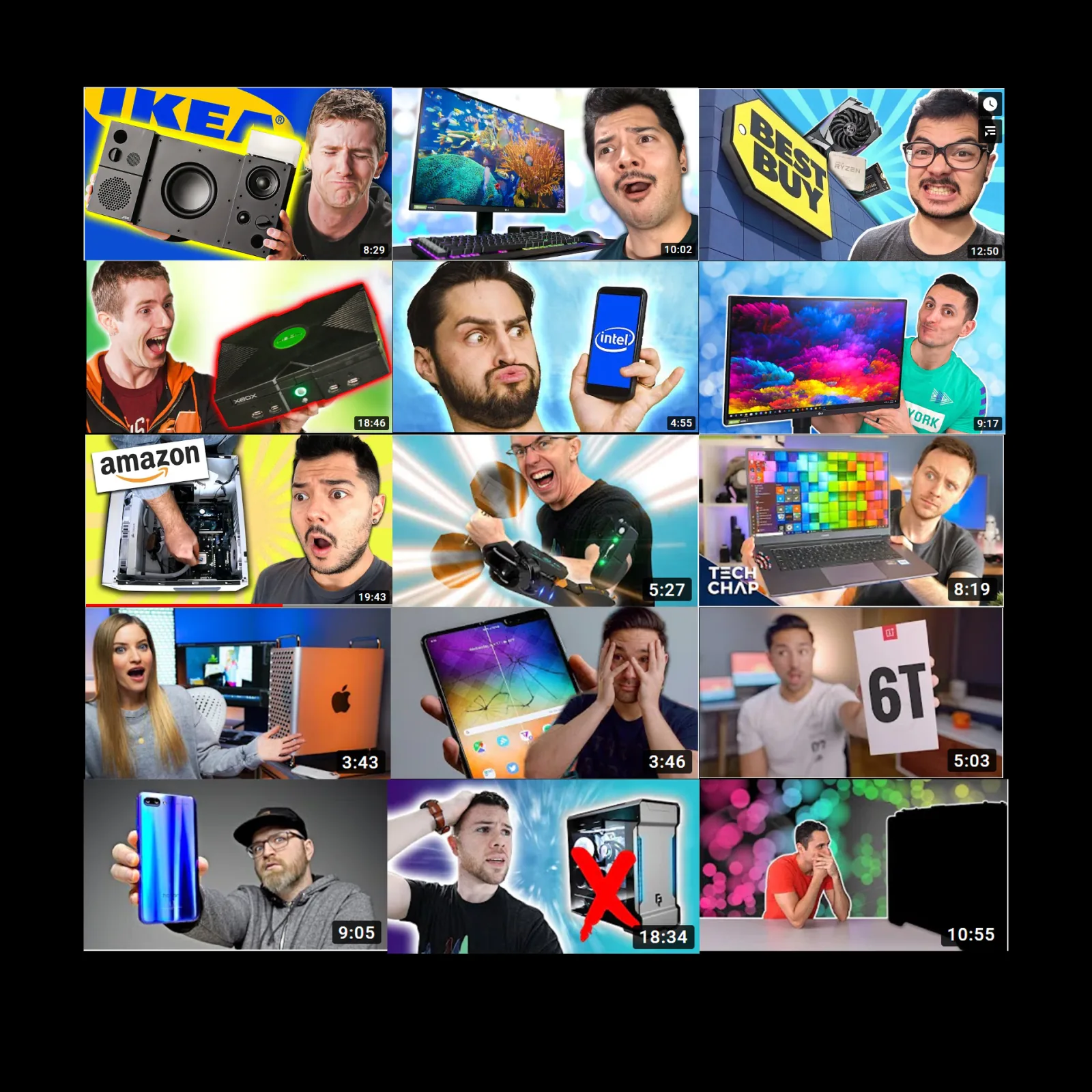
What “solving for the first second” looks like at scale. Image via a deleted user on r/pcmasterrace.
This is the first finding that is quite obvious for anyone working in sales, but must be stated for creators: catching without delivering is a net negative. The brain’s prediction error system works in both directions 2. An unexpectedly good experience produces dopamine and positive associations, but an unexpectedly bad experience produces negative predictive error. Your brain encodes this as a signal to avoid similar stimuli in the future. In summary, high CTR with low retention actively trains the algorithm against showing your content.
Think of creators who catch attention, but sustainably. Johnny Harris opens videos with a specific visual detail: a map anomaly, an archival photo, a data point. Stuff that is genuinely interesting and representative of the video’s real content. Casey Neistat’s cold opens drop the viewers into the middle of an action with zero context, but the action is the video’s subject, not a bait-and-switch. The specificity of the hook signals the specificity of the content behind it. This is catching done right: the first second functions as an honest preview of the experience to come, you don’t feel like a fool.
The Platform
By this point you’re thinking “the platform defines this”, and it’s kind of true as well. Content performance is a function between three systems: the platform’s algorithm, the audience’s behavior, and the creator’s consistency. None of these systems cares about an abstract definition of “quality”, whether that is good image quality, good sound or even if your content changed someone’s life. Each of them cares only about the specific measure signals it expects.
Todd Beaupré - YouTube’s Director of Growth - said YouTube’s recommendation engine has evolved from optimizing for raw watch time to what the company calls “satisfaction-weighted discovery” 6. It now incorporates post-view surveys (“Was this video worth your time?”), comment sentiment analysis, rewatch rates, and post-watch behavior (did the viewer search for more on this topic, or did they leave the platform?). The algorithm is now attempting to approximate whether the viewer valued the experience, not simply whether they consumed it.
TikTok’s algorithm weights completion rate above all other factors, which makes a lot of sense for a platform focusing on shorter videos 7. A 15-second video with 80% completion consistently outperforms a 60-second video with thousands of likes, but 16% completion rate. The system determined that finishing a piece of content is a stronger signal of value than any form of explicit engagement. Instagram’s algorithm followed a similar trajectory: prioritizing saves and shares which require deliberate action and signal genuine value over likes, which are cheap.
The consequence of these shifts is that the gap between content that performs and content that is good is narrowing measurably, even if slowly and imperfectly. Five years ago, engagement bait could generate massive performance metrics, while today it’s suppressed by most platform algorithms. The system has learned that attention isn’t necessarily the same as value, and reaction isn’t necessary satisfaction.
Performance is still a system problem in its essence, and systems can be gamed. The content that performs best is often content that has found a temporary arbitrage, that is, a format the algorithm hasn’t yet discounted, a topic at peak public interest, a “hack” that hasn’t been patched. You can try to reinvent yourself and become hostage of every new tendency that comes up, or you can give up permanently chasing hacks and actually build something harder to replicate: an audience that actively seeks you regardless of algorithmic distribution.
This means optimizing for performance and building for “true fans” are often opposing strategies 8. Viral content attracts casual viewers who are unlikely to convert to fans, while niche content attracts fewer viewers but a much higher percentage of people who will return. MrBeast operates at a scale where this trade-off doesn’t apply - his audience is so large that even a small percentage of true fans represents a lot of people. You’re not MrBeast, you need to make this decision. You can play the numbers game and keep trying to catch the algorithm’s attention, or you can build an audience that cares about you specifically.
The Memorability
If catching is a 50-millisecond event and performing is a 48-hour window, staying is measured in weeks, months, years. Content that stays has lodged itself in the viewer’s long term-memory and might even become part of how they understand the world. This is by far the hardest thing to achieve and the least studied, because it’s the least measurable. No platform is out there tracking “how often did the viewer think about this video in the shower three weeks later”.
Uri Hasson’s neural coupling research at Princeton demonstrates that when a storyteller and listener are deeply in sync - when the listener’s brain activity mirrors and even anticipates the speaker’s - information transfers more effectively into long-term memory 9. The degree of coupling predicts comprehension and recall. “When I say ‘brain’ and you imagine an organ, we are coupled in time and space”, Hasson explained. “Our brains become like a simple superbrain” 10. So the missing component to make content stay with people is actually the depth of mutual understanding between creator and audience.
Character driven stories with dramatic tension arcs trigger oxytocin release in viewers, which in turn produces empathy, trust, and behavioral change even. In Paul Zak’s research on oxytocin and narrative, participants who watched a tension-driven story about a father and his terminally ill son donated 56% more money to charity than those who watched a factual description of the same situation 11. The story had to have both elements: tension (something unresolved) and character (someone to empathize with), facts alone didn’t produce the effect.
The best content creators do this all the time. Johnny Harris’ best work takes a geopolitical topic and grounds it in a specific human story that makes the abstract concrete, human. Cleo Abram describes her approach as making the viewer feel “simultaneously that the world is more complex than they thought, and that they are smart enough to understand it” 12.
The concept of “desirable difficulty” from learning science is another thing that came up in the research and explains why some content stays. Robert Bjork’s research established that conditions which make learning harder in the moment improve long-term retention dramatically 13. Content that does the viewer’s thinking for them is pleasant to consume, but impossible to remember. Content that requires the viewers to make connections and fill in gaps is less comfortable, but far more memorable. The best creators embed desirable difficulty instinctively by posing a question and letting it sit, or presenting evidence before conclusions.
Specificity is the mechanism by which content becomes memorable. Abstract statements activate language-processing regions of the brain. Specific concrete details activate the regions associated with real experience, the motor cortex, visual cortex, olfactory cortex 14. When you read “she walked across the room”, your brain processes language; when you read “she dragged her bare feet across the cold tile floor”, your brain simulates this experience.
There is also a temporal component to staying: content that stays often rewards revisiting. You rewatch The Office for the third time now and get something new out of it. Might be a detail you missed before or just attributing different meaning to things now that you know the end, you seek that feeling you had watching the first time and get something new. Rick Rubin’s concept of the “seed” applies here: the best creative work contains compressed meaning that unpacks over time. “The ability to look deeply is the root of creativity”, Rubin wrote 15. Content that stays with you is content where the creator looked deeply, and you need to digest.
The Genuineness
“The most personal is the most creative” said Martin Scorsese, famously quoted by Bong Joon-ho during his 2020 Oscar acceptance speech 16. Genuine is about origin; where the work came from, and whether a real person is behind it, with their own experiences and points of view.
A piece of content can catch, perform, and even stay without being genuine. A brand video with a focus-grouped script and A/B-tested thumbnail could do all three, but no one would call it genuine, because genuine is not really a property of the output. It’s a property of the relationship between the creator and the work. It’s about having a fingerprint, coming from a real perspective.
This is more important today because genuineness is the one thing AI can’t replicate, and AI-generated content already accounts for over 50% of all English-language web content 17. Consumer preference for AI-generated content went from 60% in 2023 to just 26% in early 2026 18; people are getting good at noticing AI slop. The marketing is correcting toward humanity because genuineness is the signal that the audience is interacting with a mind, human brains are built to care about that - humans are what we interact with since the day we’re born.
When Anderson Cooper asked Rick Rubin what he contributes as a producer (given that he plays no instruments and operates no equipment), Rubin answered: the confidence that he has in his taste and his ability to express what he feels 19. For Rubin, taste is not an opinion; it’s a trained perceptual instrument, calibrated through decades of consuming and creating, that can detect the difference between something that has life and something that is just… competent. The human sensibility is filtering, this gives it the fingerprint.
Ira Glass identified something else: everyone who enters a creative field does so because they can recognize quality; they have taste. The ability to produce work that matches that taste though lags behind, sometimes for years. He called this “the gap” 20, and most people quit in this gap. Those who don’t, who push through years of disappointing themselves, might eventually develop skills that can match their judgement. The genuine content becomes possible not when the creator has learned the rules, but when they internalized the rules deeply enough to break them, make them theirs.
For the empirical grounding, we can take a look at Jerry Uelsmann’s ceramics parable, drawn from a real experiment 21. A ceramics class was split in two; half were graded on the quantity of pots produced, half were graded on the quality of a single pot. At the end of the semester, the highest-quality pots all came from the quantity group; they had learned from their mistakes, iteration by iteration. While volume itself doesn’t produce genuine work directly, it closes the gap between taste and skill, and closing that gap is the prerequisite. It’s corny, but you need to make a bunch of shitty content to get to good content.
Volume gets you from zero to competent, but not everyone can be Martin Scorsese. The leap from content to genuine requires something that cannot be systematized: vulnerability.
Brené Brown’s research established vulnerability as a prerequisite for meaningful creative work 22; vulnerability is not emotional exhibitionism, it’s uncertainty, risk, and emotional exposure. It’s the willingness to throw something out there and not control the reception in any way, express ideas you might be wrong about, show a part of yourself that might be rejected. The issue is shame literally shuts down portions of the frontal cortex, pushing the brain into fight-or-flight mode 23, so creating consensus eliminates the very neural conditions required for originality. You are incapable of being original while playing it safe.
Georgetown’s Renee DiResta identified that audiences expect creators to have strong perspectives 24; the creator who says “I might be wrong, but I think this, and here’s why” is doing something that institutional content can’t replicate. This defines genuine. Rubin distilled this into a hierarchy: “If you think ‘I don’t like it but someone else will’, you’re not making art for yourself. You’ve found yourself in the business of commerce” 15. Genuine content is made by someone who would have made it even if no one was watching it in the first place; not because they don’t care about having an audience, but because the work came from a place that exists independent of the audience’s reaction to it.
Another relevant component to this is subtraction. Antoine de Saint-Exupéry said it: “Perfection is finally attained not when there is no longer anything to add, but when there is no longer anything to take away” 25. Arthur Quiller-Couch in his 1916 book On the Art of Writing told writers to murder their darlings 26 - sentences, characters, scenes they were deeply in love with; usually because it just sounds clever or shows off rather than actually moving the story somewhere. To make genuineness evident is not to include everything the creator knows and feels about a topic, it’s making each and every element earn its place; to have the courage to remove what doesn’t belong even when you love it.
Genuine content can still fail, and it does all the time if it catches nobody’s attention. Being genuine isn’t a guarantee of success, it’s a prerequisite for making something that people want to give a chance.
The Overlap
Ok, now that we talked enough about these 4 reductive categories, let’s mix and match with a table to make it easier and see what we get.
With 4 possible fields and either active or not for each, we get 2^4 or 16 possibilities (you can also just count the amount above), but we’ll talk more deeply about a few of the most interesting ones.
Noise is the default: nothing catches, nothing performs, nothing stays, nothing is genuine. This was already most of what got published on the internet, now it’s an even larger percentage since writing became prompting AI for a lot of people. It’s filler, made to fill feeds, blogs, videos, and creators start here; but you shouldn’t stay here for too long.
Clickbait content is noise but moved in the worst possible direction: catches, but doesn’t deliver. No performance over time, no memorability, no fingerprint; it’s just exploiting the prediction-error mechanism to earn attention it can’t justify. This makes the audience distrust the creator who needs to keep attracting more people.
Trend Riding is what you see a lot: content that performs without even needing necessarily to catch. It’s just riding the latest algorithmic wave, people watch it because they’re interested in the topic or whatever the platform is currently amplifying.
Well crafted content catches, performs, and stays, but isn’t necessarily genuine. Lots of high-end brand campaigns and studio productions where everything works and performs well for the general public. This is ok, and a lot of people do it and make a career out of it, but don’t expect to move anyone.
Viral Accident is that one hit wonder, what we used to call “viral videos”; usually something funny that someone happened to be recording and worked. Creators can also do this, you see all the time the one-hit wonders where a single video of a creator does really well for some reason (both in views and watch time), but the creator can’t really sustain it. This is not failure, but some creators mistake the viral moment for their identity and spend years trying to recreate it instead of actually building an identity.
Legacy happens when a creator won the catching game already, so they no longer need to play it. That’s when you don’t need to catch users to perform, you already have an audience, an identity; people will do the marketing for you. Legacy is earned, not engineered; it takes lots of time and effort to actually build it.
Underground content is niche and personal; doesn’t catch and doesn’t perform, and that’s usually part of the charm: a newsletter with 800 subscribers who read every word or a podcast that three thousand people hear every episode religiously. Kevin Kelly’s 1000 True Fans model 8 points this way as the most viable category for independent creators: if each subscriber pays $150 a year, the creator earns 120k without worrying about algorithms. The content stays because it’s deeply relevant to a specific audience, doesn’t perform because it’s a niche audience and platforms want breadth. Works perfectly well as a business and creative practice, the usual modus operandi is associating it to another product. People might follow you because of a newsletter and you don’t make money directly off it, but you sell your book and consulting to them.
The Unicorn is the rare convergence of all four; catches, performs, stays, and is genuine. These are sparse and are not accidents, but the product of thousands of hours of practice, development of taste, courage to have a real point of view, discipline to cut what doesn’t serve the work and… a lot of failing. No creator will produce this consistently, but you know it when you see it.
You can think of examples for each category for yourself, but I want to argue for Baby Reindeer (Netflix, 2024) as a unicorn:

Baby Reindeer (Netflix, 2024). Image: Netflix.
It catches, the premise is an instant hook: a comedian is kind to a woman at a bar and she becomes his stalker; male sexual abuse is rarely talked about. It performed really well, was most-watched Netflix show for weeks in 2024, massive social media discussion, people were even investigating real-life “Martha” and it became its own news cycle. It changed how people talk about stalking, male sexual abuse, and about victimhood not being clean; it started conversation about why Donny kept going back, why he didn’t just block her. It definitely stayed. Also, Richard Gadd wrote it about his own life, own stalking, own sexual abuse. He performed it first as a one-man Edinburgh Fringe show, alone on stage, years before Netflix was even involved. The vulnerability is so extreme that it’s almost hard to watch, he’s showing the parts of himself that are the least flattering, nobody else can make this show because nobody else lived it.
The most interesting part about it is that the genuine part came first: one guy in a room telling his story to a small audience in The Fringe show. Starts as an underground content, then craft turns it into a script, which catches Netflix’s attention and only then is performed globally.
The Goodness
If you’ve been reading since the beginning, you might remember that my goal with this research was understanding why most content created today is shit and what good content even is. Well, I have an answer for the first one: people are trying to optimize for the wrong things. The second one is harder because “good” is not only intrinsically personal, but also depends on what the creator was trying to do and who they were making it for. I hate the cartoons my nephews watch, but they love it.
In summary, I didn’t really get an answer for what makes content good, but we can approximate getting to this point. The system with the four variables measures behavior, but the creator must measure intent and craft. Rubin’s hierarchy (make it for yourself, then offer it to the audience) 15 is a decision making heuristic: if you want to know whether a piece of content is good for you, ask “would I want to find this if someone else made it?” instead of asking “will this perform?”. This integrates your taste, standards, understanding of your audience, your sense of what matters.
The categories are the tools to understand the content, good or not is the destination you set. It’s different for every creator and audience, but when you are creating stuff, be honest. Both with yourself about what you’re making and why; and with your audience about what they’re getting. Making content that performs and you don’t personally love is ok if you have another goal behind it, but make sure to have your goal in mind so you don’t feel hollow every night when you go to sleep.
How to cite this
Benav, I. (2026). “What makes content good.” Sapari Blog. https://sapari.io/blog/what-makes-content-good
@article{benav2026content,
  author  = {Igor Benav},
  title   = {What Makes Content Good},
  journal = {Sapari Blog},
  year    = {2026},
  url     = {https://sapari.io/blog/what-makes-content-good}
}
References
Footnotes
-
Potter, M.C. et al. (2014). “Detecting meaning in RSVP at 13 ms per picture.” Attention, Perception, & Psychophysics, 76(2), 270–279. ↩
-
Schultz, W. (1998). “Predictive Reward Signal of Dopamine Neurons.” Journal of Neurophysiology, 80(1), 1–27. ↩ ↩2
-
MrBeast (Jimmy Donaldson). “How to Succeed in MrBeast Production.” Internal production handbook, leaked 2024. ↩
-
Loewenstein, G. (1994). “The Psychology of Curiosity: A Review and Reinterpretation.” Psychological Bulletin, 116(1), 75–98. ↩
-
ReelMind (2024). “Killing the Cliché: Why All YouTube Thumbnails Look the Same and How to Break Free.” ↩
-
Beaupré, T. (2025). Interviews on YouTube’s satisfaction-weighted discovery algorithm. Cited in multiple industry publications. ↩
-
Dataslayer (2025). “TikTok Algorithm 2025: Complete Marketer’s Guide.” ↩
-
Kelly, K. (2008). “1,000 True Fans.” The Technium. Updated for Ferriss, T. (2016). Tools of Titans. ↩ ↩2
-
Hasson, U. et al. (2010). “Speaker–listener neural coupling underlies successful communication.” Proceedings of the National Academy of Sciences, 107(32), 14425–14430. ↩
-
Hasson, U. Interview in Future of StoryTelling (FoST) Q&A series. ↩
-
Zak, P.J. (2014). “Why Your Brain Loves Good Storytelling.” Harvard Business Review. Based on research published in Barraza, J.A. & Zak, P.J. (2009). “Empathy toward Strangers Triggers Oxytocin Release and Subsequent Generosity.” Annals of the New York Academy of Sciences, 1167, 182–189. ↩
-
Abram, C. Cited in interviews with The Video Consortium and PYYRAH. ↩
-
Bjork, R.A. (1994). “Memory and Metamemory Considerations in the Training of Human Beings.” In Metcalfe, J. & Shimamura, A. (Eds.), Metacognition: Knowing About Knowing, MIT Press. ↩
-
Bergen, B.K. (2012). Louder Than Words: The New Science of How the Mind Makes Meaning. Basic Books. ↩
-
Rubin, R. (2023). The Creative Act: A Way of Being. Penguin Press. ↩ ↩2 ↩3
-
Bong Joon-ho (2020). Academy Awards acceptance speech for Best Director, Parasite. Quoting Martin Scorsese. ↩
-
Futurism (2025). “Over 50 Percent of the Internet Is Now AI Slop, New Data Finds.” Citing research from Originality.ai. ↩
-
Digiday (2025). “After an oversaturation of AI-generated content, creators’ authenticity and ‘messiness’ are in high demand.” ↩
-
Rubin, R. (2023). Interview on 60 Minutes with Anderson Cooper, CBS. ↩
-
Glass, I. (2009). Interview on creative work and “the gap.” Widely circulated via Current TV and subsequent transcriptions. ↩
-
Bayles, D. & Orland, T. (1993). Art & Fear: Observations on the Perils (and Rewards) of Artmaking. Image Continuum Press. Based on an experiment by photography professor Jerry Uelsmann, University of Florida. ↩
-
Brown, B. (2012). Daring Greatly: How the Courage to Be Vulnerable Transforms the Way We Live, Love, Parent, and Lead. Gotham Books. Also: Brown, B. (2012). “Listening to Shame.” TED Talk. ↩
-
Brown, B. (2012). “Listening to Shame.” TED Talk. Referencing neuroscience research on shame and prefrontal cortex inhibition. ↩
-
DiResta, R. Cited in Georgetown University (2024). “How Social Media Can Shape Public Opinion.” ↩
-
de Saint-Exupéry, A. (1939). Terre des hommes (Wind, Sand and Stars). Translated from French. ↩
-
Quiller-Couch, A. (1916). On the Art of Writing. Cambridge University Press. Lecture XII: “On Style.” ↩